International Demonstration Teaching Team
for Data Structure and Algorithm Analysis
一、课程简介
Introduction
《数据结构与算法》(Data structure and algorithm analysis)是西里西亚智能科学与工程学院软件工程专业本科二年级学生的一门专业必修课程。本课程于秋季学期开设,总计48学时,3.0学分,采用全英文教学模式。课程由波兰西里西亚技术大学与燕山大学人工智能学院中外双方教师联合授课。该课程以计算机科学与软件工程核心理论为基础,融合了算法设计、复杂度分析、数据组织与存储、程序优化及实践应用等内容,以能力培养与工程实践为导向,旨在培养学生的专业素养及创新思维,对后续专业核心课程学习、软件开发能力提升及国际化软件工程人才培养具有重要支撑作用。
Data Structure and Algorithm Analysis is a compulsory core course for sophomore students majoring in Software Engineering at the Silesian College of Intelligent Science and Engineering. Offered in the autumn semester, the course consists of 48 class hours with 3.0 credits and is delivered entirely in English. It is co-taught by faculty from Silesian University of Technology (Poland) and the School of Artificial Intelligence, Yanshan University.
Based on the fundamental theories of computer science and software engineering, the course integrates algorithm design, complexity analysis, data organization and storage, program optimization, and practical applications. Oriented toward ability cultivation and engineering practice, it aims to develop students’ professional competence and innovative thinking. The course provides essential support for advanced core courses, software development capability, and the cultivation of internationalized software engineering talents.
二、团队成员
Team Members

Bożena Wieczorek,博士,担任《数据结构与算法》课程的外方教师。现就职于西里西亚技术大学自动控制、电子与计算机科学学院助理教授。主要研究方向包括算法、并行处理等领域。
Dr. Bożena Wieczorek serves as an international instructor for the "Data Structures and Algorithms Analysis" course. She is currently an Assistant Professor at the Faculty of Automatic Control, Electronics and Computer Science at the Silesian University of Technology. Her primary research interests include algorithms and parallel Programming.

Jacek Stój,博士,担任《数据结构与算法》课程的外方教师。现就职于西里西亚技术大学自动控制、电子与计算机科学学院副教授。主要研究方向包括分布式工业计算机系统、工业以太网、融合通信网络以及运营技术(OT)的网络安全。
Dr. Jacek Stój serves as an international instructor for the "Data Structures and Algorithms Analysis" course. He is currently an Associate Professor at the Faculty of Automatic Control, Electronics and Computer Science at the Silesian University of Technology. His primary research interests include distributed industrial computer systems, Industrial Ethernet, converged communication networks, and cybersecurity for Operational Technology (OT).
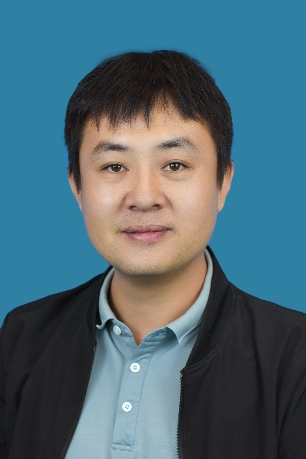
谢志刚,博士,《数据结构与算法》课程中方主讲教师、助课教师。燕山大学人工智能学院(软件学院)软件工程系讲师。主要研究方向包括物联网、边缘智能、分布式处理、强化学习、大数据等。
Dr. Xie Zhigang serves as a lead instructor and teaching assistant for the "Data Structures and Algorithms Analysis" course. He is a lecturer in the Department of Software Engineering at the School of Artificial Intelligence (School of Software), Yanshan University. His primary research interests include the Internet of Things (IoT), edge intelligence, distributed processing, reinforcement learning, and big data.
三、团队合作
Teamwork
1.开课前沟通
1. Pre-course Communication
课程开课前,中外双方教师通过线上邮件充分沟通,结合授课学生的专业特性,围绕理论内容编排与课程考核方式等核心议题展开研讨,明确了适配学生知识水平与能力培养的课程知识体系与实验内容,为学生专业素养的系统提升筑牢了基础。
Prior to the course commencement, Chinese and foreign instructors conducted in-depth communication via email. Based on the students’ major characteristics, they focused on core topics including theoretical content design and course assessment methods, defined the curriculum system and experimental content tailored to students’ knowledge level and ability development, and laid a solid foundation for the systematic improvement of students’ professional competence.
外教抵达中国后,教务部门及时组织中外教师联合座谈会,进一步敲定课程学时分配、考核细则及教学组织形式等关键事项,为教学工作的有序推进提供了坚实保障。图 1和图2 为中外双方教师研讨交流及会后的合影留念。
After the foreign teacher arrived in China, the academic affairs department promptly held a joint symposium to finalize key details such as class hour allocation, assessment criteria and teaching organization, ensuring the orderly implementation of teaching activities. Figure 1 shows a group photo of Chinese and foreign teachers after the discussion and exchange.
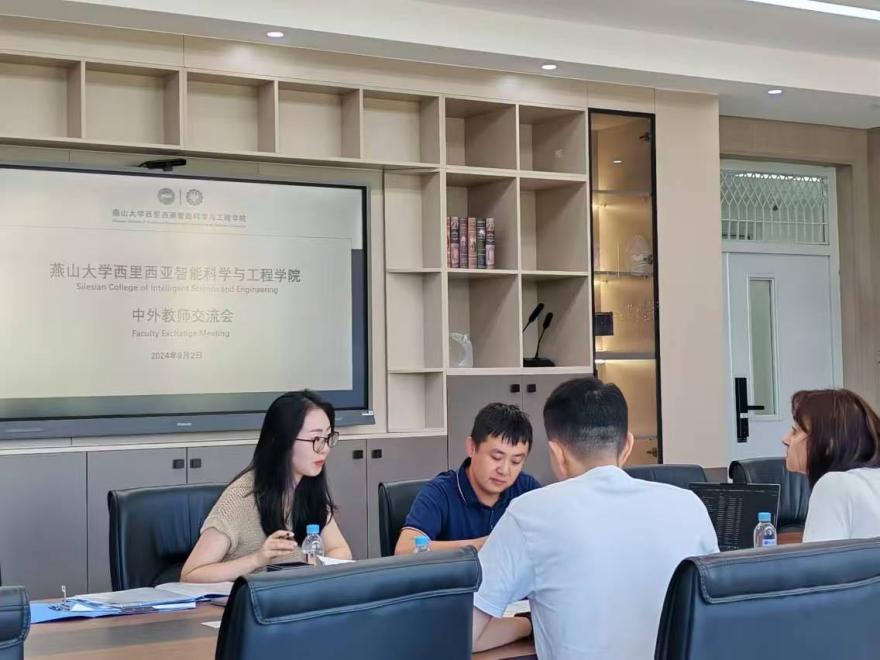
图1 中外双方教师研讨交流
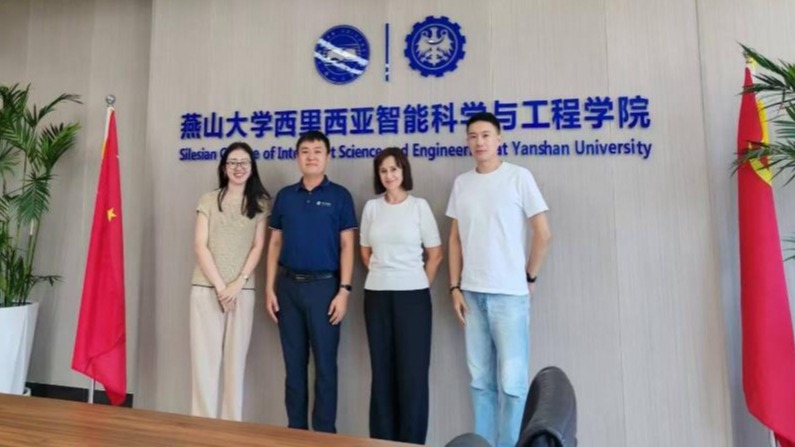
图2 中外双方教师会后合影
2.授课过程
在授课过程中,Bożena 和Jacek博士负责课程理论知识的讲授,图3和图4为外方教师授课的照片。他们不仅将波兰西里西亚技术大学独特的办学理念、文化特色与教学传统融入课堂教学,还通过互动式、启发式教学方式,引导学生积极参与课堂交流与学术讨论。在此过程中,学生由被动接受知识转向主动探索与思考,不仅深化了对课程内容的理解,也提升了跨文化交流能力和创新实践能力。图5为Bożena博士课上同学生互动的照片。图6为中方主讲教师谢志刚授课的照片,注重理论与实践相结合,引入具有代表性的实际案例,引导学生主动思考、探究解决方案,帮助学生提升知识迁移能力和实际应用能力。
During the teaching process, Dr. Bożena and Dr. Jacek were responsible for delivering the theoretical lectures of the course. Figures 3 and 4 present photographs of the foreign instructors during their teaching sessions. They not only integrated the unique educational philosophy, cultural characteristics, and teaching traditions of the Silesian University of Technology in Poland into classroom instruction, but also adopted interactive and inquiry-based teaching approaches to encourage students to actively participate in classroom communication and academic discussions. Through this process, students shifted from passive knowledge acquisition to active exploration and critical thinking, which not only deepened their understanding of the course content but also enhanced their cross-cultural communication skills and innovative practical abilities. Figure 5 shows a photograph of Dr. Bożena interacting with students during the class. Figure 6 presents a photograph of the Chinese instructor, Dr. Zhigang Xie, during his teaching session. Dr. Xie emphasized the integration of theory and practice by introducing representative real-world cases, guiding students to actively analyze problems and explore solutions. This teaching approach effectively improved students’ ability to transfer knowledge and apply theoretical concepts to practical situations.
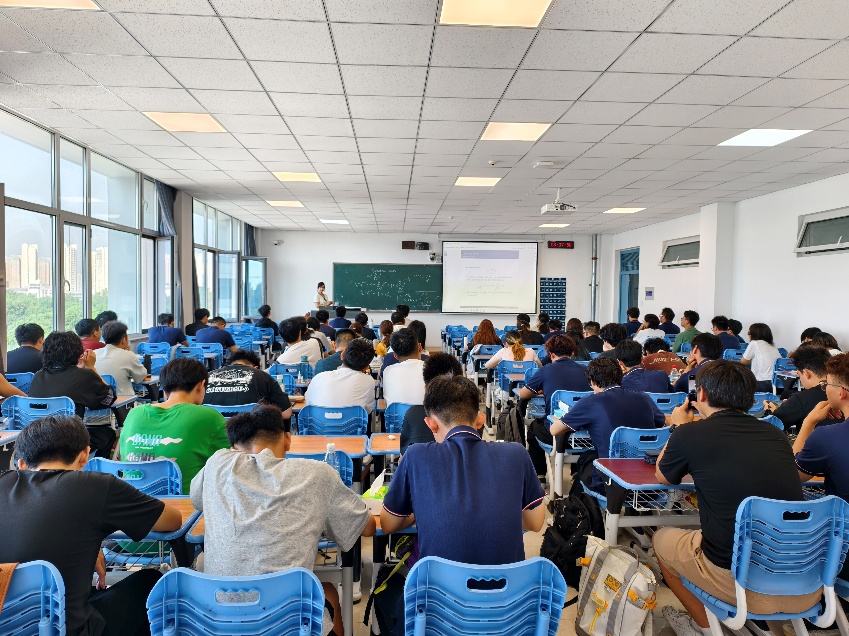
图3 Bożena 博士授课课堂
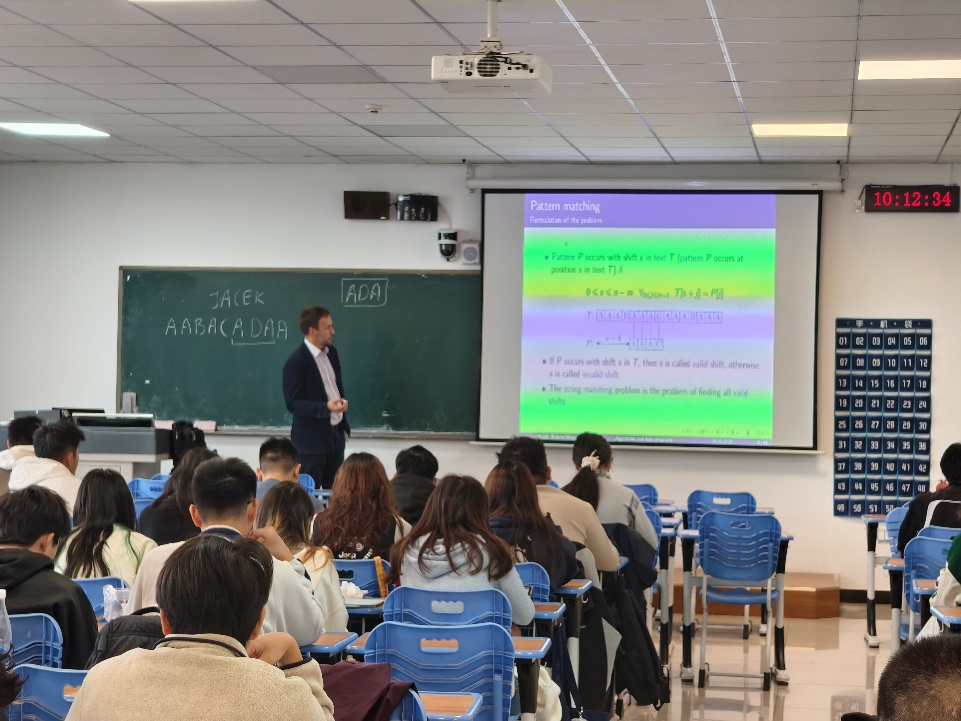
图4 Jacek博士授课课堂
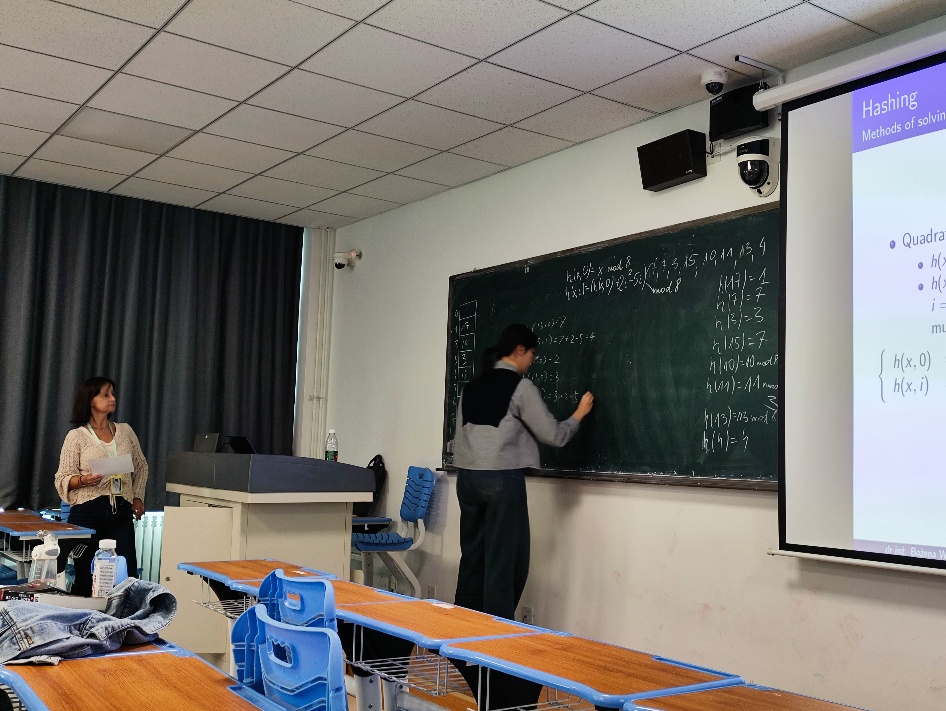
图5 课堂互动教学
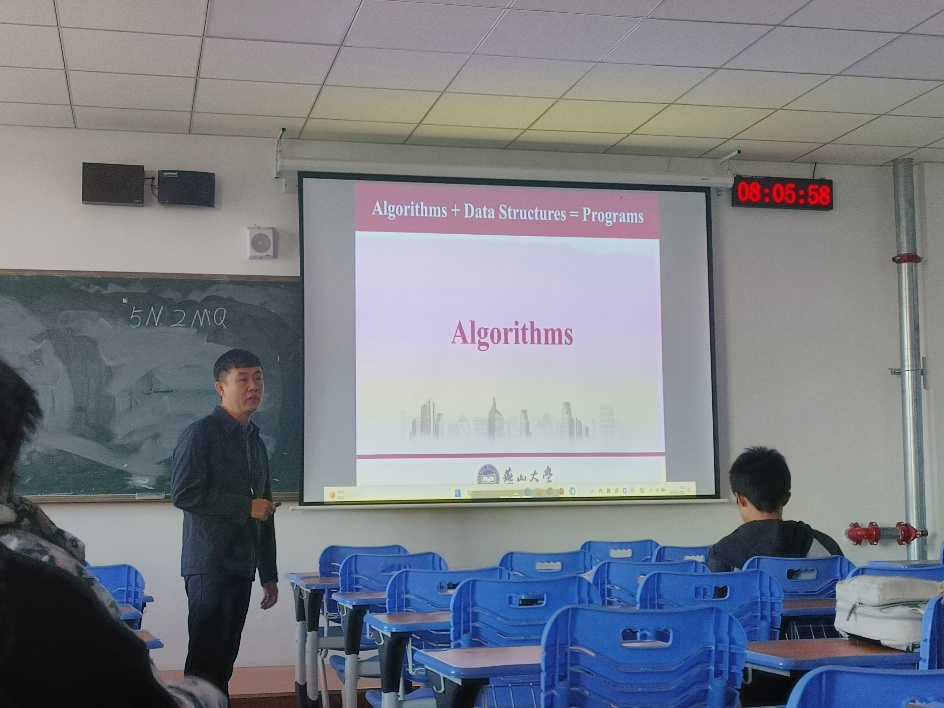
图6 中方教师授课
3.线下线下双语混合式教学
中方老师借助中外教学资源搭建线上线下双语混合式教学方式,通过学习通教学平台创建双语孪生课程(图7),帮助学生克服语言关,向学生发送课程相关资料,并解答学生提出的问题。上课时使用雨课堂进行教学(图8),师生互动人次达3935人次。中方教师利用PTA创建课后实践题目每周一测和考试(图9),带领学生自建算法学习平台(图10),帮助学生巩固课堂所学知识;创建QQ群进行答疑(图11),推荐学习资料和学习方法,引导学生借助大模型辅助课程学习。中方老师还及时与外教沟通(图12),确保外教能够根据学生们的反馈对课程内容进行及时的调整和优化。
The Chinese instructors utilized both Chinese and international teaching resources to develop an online–offline bilingual blended teaching model. By establishing a bilingual twin course on the Xuexitong teaching platform (Figure 7), they helped students overcome language barriers, provided course-related learning materials, and responded to students’ questions in a timely manner. During classroom instruction, the Rain Classroom platform was adopted to facilitate teaching and learning interactions (Figure 8), with a total of 3,935 teacher–student interactions recorded.The Chinese instructors also used the PTA platform to design after-class programming exercises (Figure 9) and guided students in building their own algorithm learning platform (Figure 10), enabling students to consolidate and apply the knowledge acquired in class. In addition, a QQ group was established for academic support and communication (Figure 11), where instructors shared recommended learning resources and effective learning strategies, while encouraging students to utilize large language models to assist their course learning.Furthermore, the Chinese instructors maintained timely communication with the foreign instructors (Figure 12) to ensure that the course content could be adjusted and optimized according to students’ learning feedback.
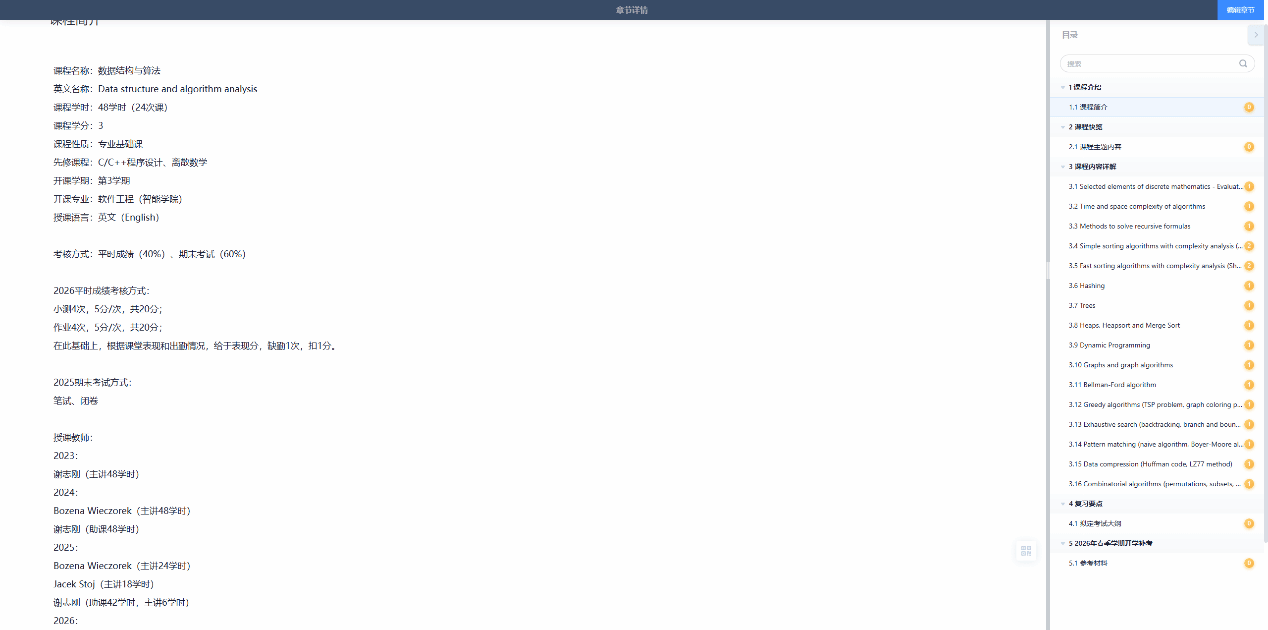
图7 学习通教学平台创建双语孪生课程
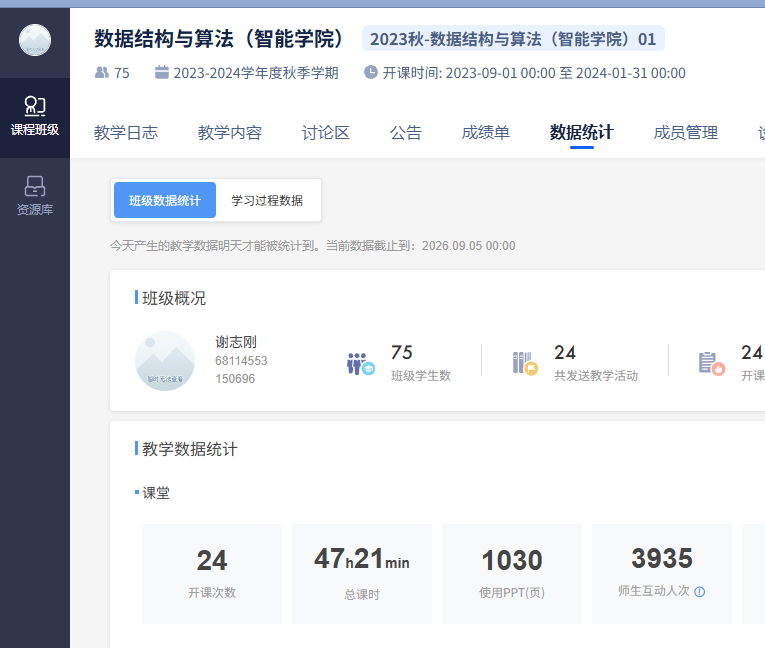
图8 雨课堂数据
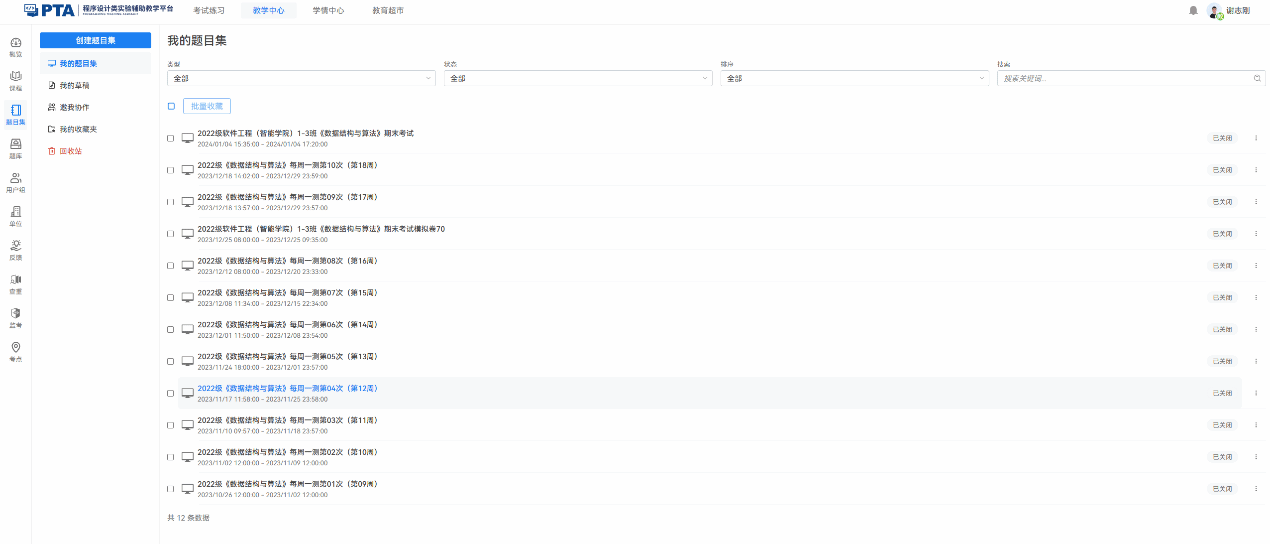
图9 PTA每周一测和考试

图10带领学生自建算法学习平台
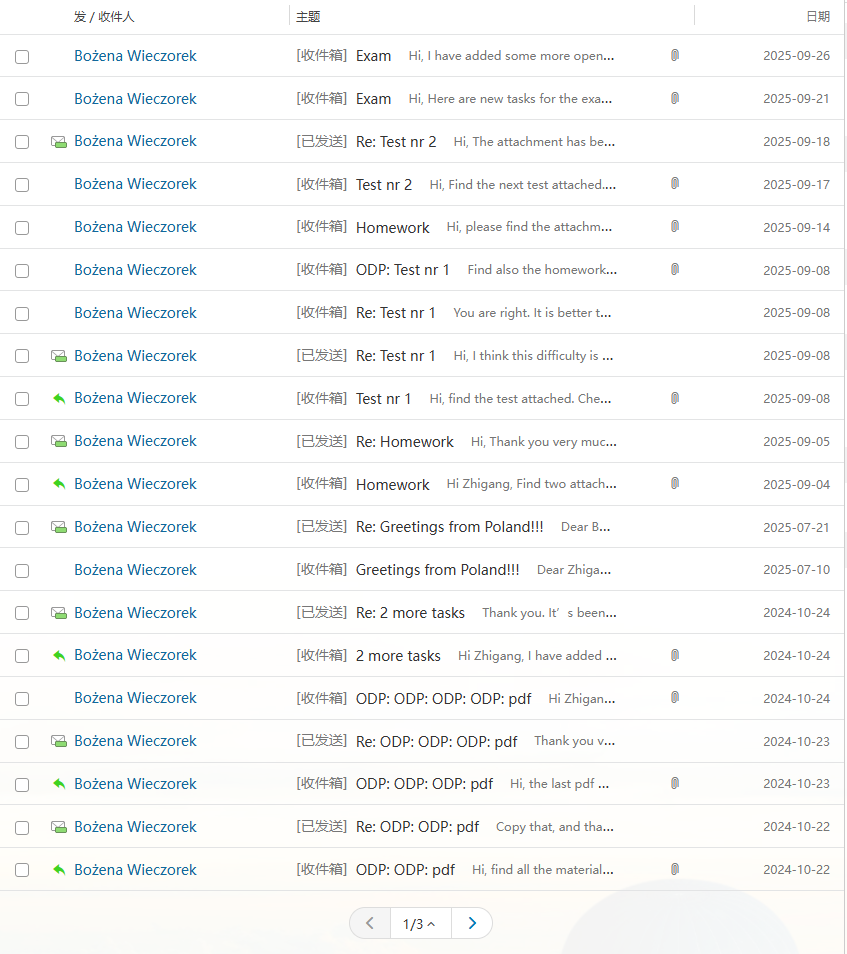
图11 创建QQ学习群
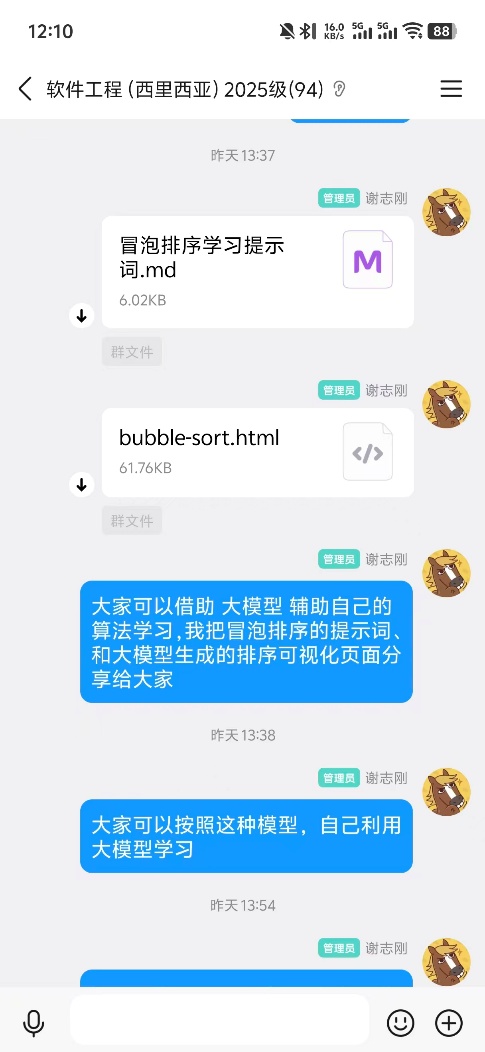
图12 中外教师邮件沟通交流课程
四.课程内容
Course Content
(1)绪论
[教学目的与要求]:理解算法的基本概念与价值,掌握算法效率的度量方法(时间 / 空间复杂度);建立数据结构与算法的关联认知,形成对后续内容的整体框架感。
[本章主要内容]:
1)算法的定义、特征及问题求解中的作用
2)算法时间复杂度(大 O 表示法等)与空间复杂度的分析方法
3)数据结构与算法的协同关系概述
(1) Introduction
[Teaching Objectives and Requirements]: Understand the basic concepts and value of algorithms, master the measurement methods of algorithm efficiency (time / space complexity); establish a cognitive connection between data structures and algorithms, and form an overall framework for subsequent content.
[Main Contents of This Chapter]:
1)Definition and characteristics of algorithms, as well as their roles in problem-solving
2)Analysis methods of algorithm time complexity (including Big O notation) and space complexity
3)Overview of the collaborative relationship between data structures and algorithms
(2)递归
[教学目的与要求]:掌握递归的核心思想(“递” 与 “归”)与实现原理;能分析递归算法的执行过程及复杂度;学会用递归解决典型问题(如阶乘、汉诺塔)。
[本章主要内容]:
1)递归的定义、基本要素(递归基、递归关系)
2)递归算法的栈帧调用机制(执行过程可视化)
3)典型递归问题(阶乘计算、汉诺塔、二叉树递归遍历)
(2) Recursion
[Teaching Objectives and Requirements]: Master the core idea of recursion (“delivery” and “return”) and its implementation principle; be able to analyze the execution process and complexity of recursive algorithms; learn to use recursion to solve typical problems (such as factorial, Tower of Hanoi).
[Main Contents of This Chapter]:
1)Definition and basic elements of recursion (base case, recurrence relation)
2)Stack frame calling mechanism of recursive algorithms (visualization of execution process)
3)Typical recursive problems (factorial calculation, Tower of Hanoi, recursive traversal of binary trees)
(3)排序算法
[教学目的与要求]:掌握常见排序算法的思想、步骤与性能特点;理解 “稳定性” 概念;能根据场景选择合适的排序算法。
[本章主要内容]:
1)排序基本概念(稳定性、内 / 外排序)
2)插入类(直接插入、希尔排序)、交换类(冒泡、快速排序)
3)归并排序、基数排序
(3) Sorting Algorithms
[Teaching Objectives and Requirements]: Master the ideas, procedures and performance characteristics of common sorting algorithms; understand the concept of "stability"; be able to select appropriate sorting algorithms according to different scenarios.
[Main Contents of This Chapter]:
1)Basic concepts of sorting (stability, internal / external sorting)
2)Insertion sorting (straight insertion sort, Shell sort), exchange sorting (bubble sort, quick sort)
3)Merge sort, radix sort
(4)哈希算法
[教学目的与要求]:掌握哈希表的概念与作用;理解哈希函数构造方法;掌握哈希冲突解决策略(开放定址、链地址);分析哈希表性能。
[本章主要内容]:
1)哈希表、哈希函数的定义与价值
2)哈希函数构造(直接定址、除留余数等)
3)哈希冲突解决(开放定址、链地址、再哈希)
4)哈希表的查找、插入、删除操作
(4) Hashing Algorithms
[Teaching Objectives and Requirements]: Master the concept and functions of hash tables; understand the construction methods of hash functions; master hash collision resolution strategies (open addressing, chaining); analyze the performance of hash tables.
[Main Contents of This Chapter]:
1) Definition and significance of hash tables and hash functions
2) Construction of hash functions (direct addressing, division remainder method, etc.)
3) Hash collision resolution (open addressing, chaining, rehashing)
4) Search, insertion and deletion operations on hash tables
(5)动态规划
[教学目的与要求]:掌握动态规划的核心思想(最优子结构、重叠子问题);能识别动态规划问题并设计状态转移方程;解决典型问题(0/1 背包、最长公共子序列)。
[本章主要内容]:
1)动态规划的思想与适用条件
2)解题步骤(状态定义、转移方程、初始条件、求解顺序)
3)典型问题(斐波那契优化、0/1 背包、最长公共子序列)
(5) Dynamic Programming
[Teaching Objectives and Requirements]: Master the core ideas of dynamic programming (optimal substructure, overlapping subproblems); be able to identify dynamic programming problems and design state transition equations; solve typical problems (0/1 knapsack, longest common subsequence).
[Main Contents of This Chapter]:
1) Ideas and applicable conditions of dynamic programming
2) Problem-solving steps (state definition, transition equation, initial conditions, solution order)
3) Typical problems (Fibonacci optimization, 0/1 knapsack, longest common subsequence)
(6)树
[教学目的与要求]:掌握树的基本概念(节点、度、层次等);理解二叉树的定义、性质与存储;掌握二叉树遍历(递归 / 非递归);了解树的应用(红黑树、二叉搜索树)。
[本章主要内容]:
1)树的基本概念与术语
2)二叉树的定义、性质与存储(顺序、链式)
3)二叉树遍历(先序、中序、后序的递归 / 迭代实现)
4)二叉搜索树、红黑树
(6) Trees
[Teaching Objectives and Requirements]: Master the basic concepts of trees (nodes, degree, levels, etc.); understand the definition, properties and storage of binary trees; master binary tree traversal (recursive / non-recursive); understand applications of trees (red-black trees, binary search trees).
[Main Contents of This Chapter]:
1) Basic concepts and terminology of trees
2) Definition, properties and storage of binary trees (sequential, linked)
3) Binary tree traversal (recursive / iterative implementation of preorder, inorder and postorder traversal)
4) Binary search trees, red-black trees
(7)堆
[教学目的与要求]:掌握堆的定义、性质与存储;掌握堆的基本操作(建堆、插入、删除、调整);理解堆排序原理;了解堆在优先队列的应用。
[本章主要内容]:
1)堆的定义与性质(大顶堆、小顶堆)
2)堆的数组存储与表示
3)堆的基本操作(向上调整、向下调整算法)
4)堆排序算法实现
5)堆在优先队列的应用
(7) Heap
[Teaching Objectives and Requirements]: Master the definition, properties and storage of heaps; master the basic operations of heaps (heap construction, insertion, deletion, adjustment); understand the principle of heap sort; understand the application of heaps in priority queues.
[Main Contents of This Chapter]:
1) Definition and properties of heaps (max-heap, min-heap)
2) Array storage and representation of heaps
3) Basic operations of heaps (up-heap, down-heap algorithms)
4) Implementation of the heap sort algorithm
5) Application of heaps in priority queues
(8)图
[教学目的与要求]:掌握图的基本概念(顶点、边、有向 / 无向、连通性等);理解图的存储(邻接矩阵、邻接表);掌握图的遍历(DFS、BFS);了解图的应用算法(最短路径、最小生成树)。
[本章主要内容]:
1)图的基本概念与术语
2)图的存储(邻接矩阵、邻接表的构造与特点)
3)图的遍历(DFS、BFS 的递归 / 迭代实现)
4)图的应用算法简介(Dijkstra、Prim、Kruskal)
(8) Graphs
[Teaching Objectives and Requirements]: Master the basic concepts of graphs (vertices, edges, directed/undirected, connectivity, etc.); understand graph storage (adjacency matrix, adjacency list); master graph traversal (DFS, BFS); understand applied graph algorithms (shortest path, minimum spanning tree).
[Main Contents of This Chapter]:
1) Basic concepts and terminology of graphs
2) Graph storage (construction and characteristics of adjacency matrix and adjacency list)
3) Graph traversal (recursive/iterative implementation of DFS and BFS)
4) Brief introduction to applied graph algorithms (Dijkstra, Prim, Kruskal)
(9)匹配算法
[教学目的与要求]:掌握字符串匹配的问题场景;理解朴素匹配的原理与局限;掌握 KMP 算法的核心(部分匹配表、next 数组);分析匹配算法的复杂度。
[本章主要内容]:
1)字符串匹配的概念与应用(文本检索)
2)朴素字符串匹配算法
3)KMP 算法的思想与实现(next 数组的构建与使用)
(9) Matching Algorithms
[Teaching Objectives and Requirements]: Master the problem scenarios of string matching; understand the principle and limitations of naive matching; grasp the core of the KMP algorithm (partial match table, next array); analyze the complexity of matching algorithms.
[Main Contents of This Chapter]:
1) Concept and application of string matching (text retrieval)
2) Naive string matching algorithm
3) Idea and implementation of the KMP algorithm (construction and application of the next array)
(10)组合算法
[教学目的与要求]:理解组合问题的特征;掌握组合算法的设计思路(回溯法的应用);解决典型组合问题(组合数计算、子集生成)。
[本章主要内容]:
1)组合问题的概念与分类(排列、组合)
2)组合算法的设计思路(递归、回溯)
3)典型组合问题求解(生成所有子集、组合数计算)
(10) Combinatorial Algorithms
[Teaching Objectives and Requirements]: Understand the characteristics of combinatorial problems; master the design ideas of combinatorial algorithms (application of backtracking); solve typical combinatorial problems (combination number calculation, subset generation).
[Main Contents of This Chapter]:
1) Concepts and classification of combinatorial problems (permutation, combination)
2) Design ideas of combinatorial algorithms (recursion, backtracking)
3) Solutions to typical combinatorial problems (generating all subsets, calculating combination numbers)
(11)穷举算法
[教学目的与要求]:掌握穷举算法的思想与适用场景;理解穷举的优化方法(剪枝策略);运用穷举解决典型问题(旅行商、数独)。
[本章主要内容]:
1)穷举算法的思想与特点
2)穷举算法的优化(剪枝条件设计)
3)典型穷举问题求解(枚举密码锁、简单数独)
(11) Exhaustive Algorithms
[Teaching Objectives and Requirements]: Master the idea and applicable scenarios of exhaustive algorithms; understand the optimization methods of exhaustion (pruning strategies); apply exhaustion to solve typical problems (traveling salesman problem, Sudoku).
[Main Contents of This Chapter]:
1) Idea and characteristics of exhaustive algorithms
2) Optimization of exhaustive algorithms (design of pruning conditions)
3) Solutions to typical exhaustive problems (enumeration for combination locks, simple Sudoku)
(12)数据压缩
[教学目的与要求]:了解数据压缩的概念与场景;掌握哈夫曼编码的原理与实现;理解哈夫曼编码的压缩效率与最优性。
[本章主要内容]:
1)数据压缩的概念(无损、有损压缩)
2)哈夫曼树的构造方法
3)哈夫曼编码的生成与解码过程
4)哈夫曼编码的压缩效率分析
(12) Data Compression
[Teaching Objectives and Requirements]: Understand the concept and application scenarios of data compression; master the principle and implementation of Huffman coding; comprehend the compression efficiency and optimality of Huffman coding.
[Main Contents of This Chapter]:
1) Concept of data compression (lossless and lossy compression)
2) Construction method of Huffman tree
3) Encoding and decoding process of Huffman coding
4) Analysis of compression efficiency of Huffman coding
(13)贪心算法
[教学目的与要求]:掌握贪心算法的思想与核心策略;理解贪心的适用条件(最优子结构、贪心选择性质);运用贪心解决典型问题(活动选择、最小生成树)。
[本章主要内容]:
1)贪心算法的思想与特点
2)贪心的适用条件(最优子结构、贪心选择性质)
3)典型贪心问题求解(旅行商问题、图着色问题)
(13) Greedy Algorithm
[Teaching Objectives and Requirements]: Master the idea and core strategy of the greedy algorithm; understand its applicable conditions (optimal substructure, greedy choice property); apply greedy algorithms to solve typical problems (activity selection, minimum spanning tree).
[Main Contents of This Chapter]:
1) Idea and characteristics of the greedy algorithm
2) Applicable conditions of greedy strategy (optimal substructure, greedy choice property)
3) Solutions to typical greedy problems (traveling salesman problem, graph coloring problem)
五、展望
Future Work
未来,《数据结构与算法》课程将持续依托西里西亚智能科学与工程学院优势,深度融合中外优质资源,优化课程体系,提升教学质量与人才培养层次。课程前期融入国际前沿案例与跨文化内容,拓宽学生国际视野,夯实语言与文化交流基础;强化互动式、探究式教学,激发自主思考与创新能力;突出创新创业实践,探索中外合作教学新模式。通过国内外资源整合与跨文化团队协作训练,既扎实传授核心知识,更培育具备全球胜任力与科研创新能力的国际化软件人才。
Going forward, the course Data Structures and Algorithms Analysis will continue to build on the strengths of the Silesian College of Intelligent Science and Engineering. It will deeply integrate high-quality Chinese and international educational resources, optimize the curriculum structure, and elevate both teaching quality and talent development.Early in the course, cutting-edge international cases and cross-cultural content will be introduced to broaden students’ global outlook and strengthen their foundation for language and cultural exchange. Interactive and inquiry-based learning will be emphasized to foster independent thinking and innovation. Greater focus will be placed on innovation and entrepreneurship practice to explore new models of Sino-foreign cooperative education.By integrating domestic and international resources and enhancing cross-cultural teamwork, the course will not only deliver rigorous core knowledge but also cultivate globally competent software professionals with strong research and innovation capabilities.